
AI agents are changing how businesses interact with technology. But what makes them different from chatbots and traditional automation, and what can they actually do for enterprises?
Artificial intelligence is rapidly becoming part of everyday business operations. Companies are using AI to analyze information, improve productivity, and automate repetitive tasks.
However, a new generation of AI technology is moving beyond simply answering questions or generating content.
This technology is known as AI agents.
Unlike traditional automation tools that follow fixed instructions, AI agents can interpret objectives, plan tasks, and interact with connected systems to achieve specific goals.
For businesses managing complex operations across finance, procurement, manufacturing, and human resources, AI agents offer new opportunities to make processes more intelligent and efficient.
1. What Is an AI Agent?
An AI agent is an AI-powered software system designed to achieve specific objectives by understanding information, making decisions, and taking actions through available tools or connected applications.
Instead of requiring users to manually perform every step, an AI agent can help coordinate multiple activities toward a defined goal.
Depending on its capabilities and permissions, an AI agent can:
- Understand requests expressed in natural language.
- Retrieve and analyze information from connected systems.
- Break complex objectives into smaller tasks.
- Select appropriate tools and workflows.
- Generate recommendations or execute authorized actions.
- Request human approval when necessary.
A Simple Business Example
Imagine a supply chain manager asking:
“Which products are likely to run out of stock next week?”
In a traditional system, the manager might need to review inventory reports, sales forecasts, and outstanding purchase orders separately.
An AI agent connected to the relevant business systems could retrieve this information, identify potential shortages, and prepare recommendations for replenishment.
The key difference is that users can communicate a business objective instead of manually navigating each individual process.
2. AI Agent vs Chatbot vs Traditional Automation
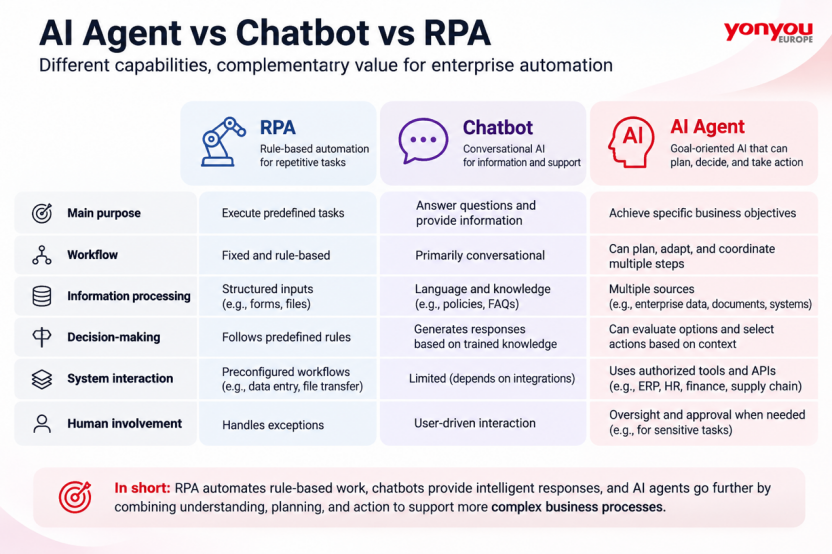
AI agents, AI chatbots, and traditional automation tools all support business productivity, but they operate differently.
| Capability | Traditional Automation / RPA | AI Chatbot | AI Agent |
| Main purpose | Execute predefined tasks | Answer questions | Pursue specific objectives |
| Workflow | Fixed and rule-based | Primarily conversational | Can plan and adapt steps |
| Information processing | Structured inputs | Language and knowledge | Multiple connected sources |
| Decision-making | Predefined rules | Generates responses | Can evaluate options and select actions |
| System interaction | Preconfigured workflows | Depends on integrations | Uses authorized tools and APIs |
| Human involvement | Exception handling | User-driven | Oversight and approval when needed |
Consider a common business process: invoice processing.
Traditional automation (RPA) can extract invoice information and enter it into an accounting system according to predefined rules.
An AI chatbot can answer questions about invoice policies or explain payment procedures.
An AI agent, when connected to the appropriate systems, could review invoice details, compare them with purchase orders, identify discrepancies, and prepare the next step for approval.
These technologies are not necessarily competitors.
In many enterprise environments, AI agents work alongside existing automation tools, ERP systems, and established business workflows.
3. How Do AI Agents Work?
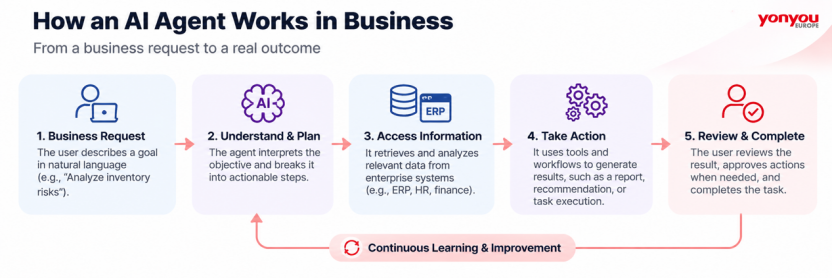
Although AI agents vary in complexity, enterprise AI agents typically follow a process involving five key capabilities.
Step 1: Understanding the Objective
The user provides a request, such as analyzing inventory risks or preparing a financial summary.
The AI agent interprets the objective and identifies the information required.
Step 2: Accessing Relevant Information
With appropriate permissions, the agent retrieves information from connected systems, including ERP applications, databases, documents, or internal knowledge sources.
Step 3: Planning the Task
The agent determines which steps are needed to complete the objective.
For more complex requests, it may divide the task into smaller activities.
Step 4: Using Tools and Executing Actions
Depending on its configuration, the agent may retrieve additional information, generate a report, prepare recommendations, or initiate an authorized workflow.
Step 5: Reviewing Results and Applying Controls
The agent presents its findings or completes permitted actions.
For sensitive activities, such as approving payments or placing purchase orders, organizations can require human authorization.
This combination of AI reasoning, enterprise information, and controlled execution allows agents to support more complex tasks than conventional automation alone.
4. Why Are AI Agents Important for Businesses?
The value of AI agents goes beyond reducing repetitive manual work.
They can change how employees interact with enterprise information and business processes.
Improving Operational Efficiency
AI agents can help employees complete information-intensive tasks more efficiently by reducing the need to navigate multiple applications and manually consolidate data.
Supporting Better Decision-Making
By analyzing information from connected business systems, AI agents can help identify exceptions, summarize relevant findings, and prepare recommendations.
Connecting Business Processes
Many enterprise tasks involve several departments and applications.
AI agents can support coordination across these systems, helping organizations reduce fragmented workflows.
Making Enterprise Software More Accessible
Instead of navigating complex menus, employees can express requests in natural language.
This can make business information easier to access, particularly for users who do not work directly with enterprise software every day.
However, these benefits depend on reliable data, appropriate system integration, security controls, and effective human oversight.
5. From AI Assistance to Enterprise AI Agents
For businesses, the next stage of AI adoption is not simply about generating better answers.
It is about connecting AI capabilities with actual business tasks, enterprise data, and operational workflows.
This is the direction behind YonWork, Yonyou’s enterprise AI workspace and agent-oriented solution.
YonWork is designed to bring AI assistance and task execution into enterprise operations, with capabilities focused on business understanding, workflow coordination, and controlled execution.
Its approach includes enterprise AI Skills, a personalized workbench, connections with business applications, and security and governance mechanisms.
YonWork also highlights practical business scenarios, including expense reimbursement, executive business analysis, talent management, and customer order fulfillment.
These examples illustrate how enterprise AI can move beyond conversational assistance toward supporting real business processes.
Explore YonWork – Enterprise AI Agent and Workspace
6. The Future of Enterprise AI
AI agents represent an important development in how businesses use artificial intelligence.
Traditional software generally requires employees to navigate applications and complete individual tasks manually. AI agents introduce a more goal-oriented approach, where users can describe what they want to achieve and receive assistance in completing the necessary steps.
However, successful adoption requires more than advanced AI technology.
Organizations must also consider data quality, system integration, security, governance, and measurable business value.
As AI agents continue to evolve, their ability to work alongside enterprise software and existing business processes will become increasingly important.
At Yonyou Europe, we help organizations explore digital transformation through enterprise software and AI technologies.
Interested in exploring enterprise AI for your business?
Contact Yonyou Europe to discuss your business requirements and discover how intelligent enterprise solutions could support your digital transformation journey.
Frequently Asked Questions
What is an AI agent?
An AI agent is an AI-powered system that can understand objectives, analyze information, plan tasks, and interact with authorized tools or applications to achieve specific goals.
What is the difference between an AI agent and a chatbot?
A chatbot primarily focuses on conversational interaction and answering questions. An AI agent can also plan tasks and use connected tools to support or execute actions.
How is an AI agent different from RPA?
RPA generally follows predefined rules and workflows. AI agents can interpret information and determine appropriate steps within defined operational boundaries.
Can AI agents work with ERP systems?
Yes. With suitable integrations and permissions, AI agents can retrieve ERP information, support analysis, and assist with selected business workflows.
