
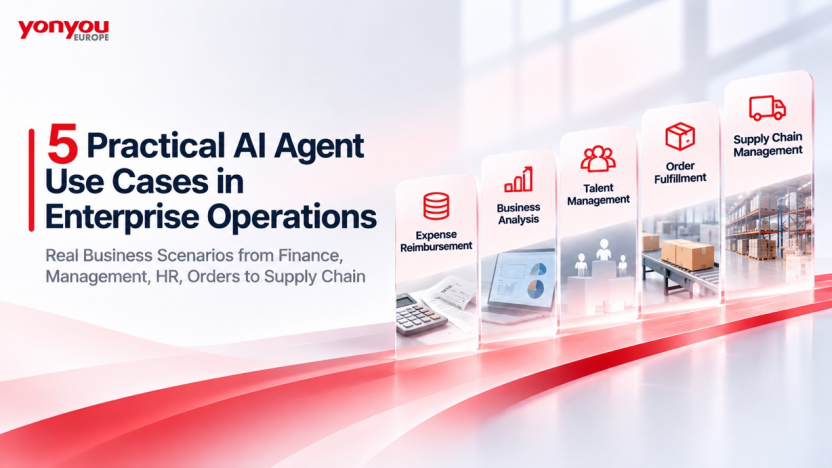
From expense reimbursement to supply chain management, discover how enterprise AI agents can help businesses streamline workflows, improve decision-making, and connect information with action.
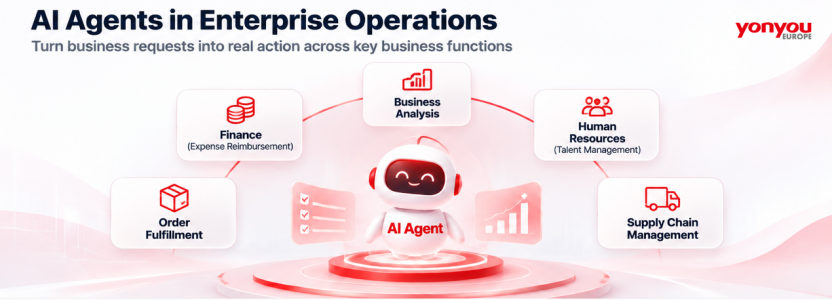
Introduction: Moving from AI Conversations to Business Execution
Artificial intelligence is becoming an essential part of enterprise digital transformation. While many organizations have experimented with AI chatbots and content generation tools, the next opportunity lies in applying AI directly to everyday business processes.
This is where enterprise AI agents come in.
Unlike conventional automation tools that follow predefined instructions, AI agents can interpret business objectives, retrieve relevant information, coordinate tasks, and support actions across connected systems.
For organizations managing finance, human resources, customer orders, and supply chains, these capabilities offer opportunities to reduce manual work and improve operational efficiency.
But where can AI agents create practical business value?
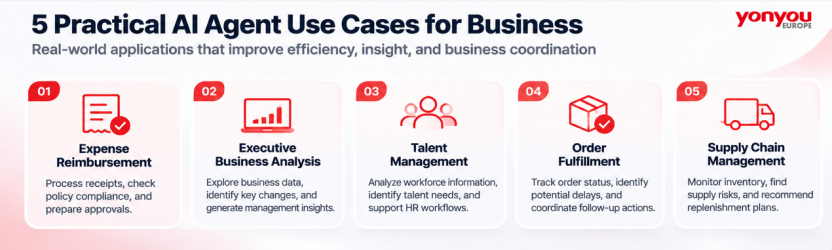
Here are five enterprise AI agent use cases that illustrate how intelligent automation can support real business operations.
1. Expense Reimbursement: Simplifying Financial Workflows
The Business Challenge
Expense reimbursement is a common administrative process that can consume significant time for both employees and finance teams.
Employees must collect receipts, complete expense forms, select appropriate categories, and submit requests. Finance departments then review supporting documents, verify compliance, and process approvals.
Incomplete information or policy violations can create delays and additional manual work.
How AI Agents Can Help
An AI agent integrated with expense management systems can support multiple stages of reimbursement.
For example, an employee could submit a receipt and request reimbursement through a conversational interface.
Depending on the available integrations and permissions, the agent could:
- Extract relevant information from receipts.
- Suggest expense categories.
- Check submitted information against company policies.
- Identify missing documents or potential exceptions.
- Prepare reimbursement requests for approval.
Business Value
AI-assisted reimbursement can reduce repetitive data entry, improve the consistency of expense submissions, and help finance teams focus on exceptions rather than routine processing.
Yonyou’s YonWork highlights expense reimbursement as one of its enterprise AI application scenarios, illustrating how AI-driven assistance can be connected with financial workflows.
2. Executive Business Analysis: Turning Enterprise Data into Insights
The Business Challenge
Business leaders frequently need to understand changes in revenue, costs, profitability, and operational performance.
However, relevant information is often distributed across ERP applications, financial reports, and departmental systems.
Answering a question such as “Why did our operating costs increase this quarter?” may require several reports and considerable manual analysis.
How AI Agents Can Help
An enterprise AI agent connected to authorized business data can support management analysis through natural-language interaction.
For example, a manager could ask:
“Which business units contributed most to the increase in operating expenses?”
The agent could retrieve relevant figures, compare reporting periods, identify significant changes, and prepare a summary for further investigation.
Potential capabilities include:
- Natural-language queries across business information.
- Financial and operational performance comparisons.
- Identification of unusual trends or exceptions.
- Generation of management summaries.
- Support for follow-up questions and deeper analysis.
Business Value
AI agents can make business information more accessible and reduce the time required to prepare initial analyses.
Rather than replacing management judgment, they help decision-makers investigate information more efficiently.
YonWork’s executive business analysis scenario reflects this approach to connecting AI assistance with enterprise management information.
3. Talent Management: Supporting Smarter HR Decisions
The Business Challenge
Human resources teams manage employee information, performance processes, organizational development, and talent planning.
These activities often involve information distributed across HR applications, internal documents, and departmental records.
HR professionals may spend considerable time consolidating information and preparing reports before they can focus on strategic workforce planning.
How AI Agents Can Help
With appropriate access controls, AI agents can help HR teams retrieve and analyze workforce information.
For example, an HR manager could ask:
“Which departments may need additional workforce development support?”
An appropriately configured agent could help summarize relevant workforce indicators, identify areas requiring review, and prepare supporting information for HR professionals.
Potential applications include:
- HR information retrieval.
- Workforce reporting and analysis.
- Talent development workflow assistance.
- Preparation of HR management summaries.
- Coordination of approved administrative tasks.
Business Value
AI-assisted talent management can reduce administrative workloads and improve access to workforce information.
However, employment-related decisions require particular care. AI-generated insights should remain subject to human review, appropriate data protection, and safeguards against unfair or discriminatory outcomes.
YonWork includes talent management among its illustrated enterprise AI business scenarios.
4. Customer Order Fulfillment: Connecting Sales with Operations
The Business Challenge
Customer order fulfillment involves several interconnected activities, including order processing, inventory availability, warehouse operations, logistics, and customer communication.
When information is fragmented across departments, employees may struggle to answer simple questions:
“Has this customer order been shipped?”
“Why is the delivery delayed?”
“Which orders require immediate attention?”
Resolving these questions can require manual coordination between multiple teams.
How AI Agents Can Help
An AI agent connected to order management and other relevant business applications could help employees investigate order status and coordinate follow-up activities.
For example, a customer service representative could ask:
“Which customer orders are at risk of delayed delivery?”
Depending on system connectivity, the agent could review order information, inventory availability, and fulfillment status to identify potential issues.
It could then prepare a summary, recommend follow-up actions, or initiate permitted workflows.
Business Value
AI-assisted order fulfillment can help organizations improve information visibility, identify exceptions earlier, and reduce repetitive communication between departments.
YonWork’s customer order fulfillment scenario illustrates the potential of connecting conversational AI with structured enterprise workflows.
5. Supply Chain Management: From Inventory Monitoring to Proactive Planning
The Business Challenge
Supply chain teams must continuously balance customer demand, inventory availability, procurement costs, and supplier performance.
Traditional ERP systems provide essential information, but employees often need to combine multiple reports to understand potential risks.
For example, identifying an upcoming inventory shortage may require reviewing stock levels, demand forecasts, outstanding purchase orders, and supplier lead times.
How AI Agents Can Help
An AI agent integrated with relevant ERP and supply chain systems could help analyze these factors together.
A procurement manager might ask:
“Which products are at risk of stock shortages over the next two weeks?”
The agent could potentially:
- Review current inventory levels.
- Compare expected demand with available stock.
- Identify products with potential shortages.
- Examine outstanding purchasing information.
- Prepare replenishment or stock-transfer recommendations.
Business Value
These applications could support faster exception identification, better planning, and more informed procurement decisions.
Unlike the four preceding YonWork scenarios, this supply chain example illustrates a potential enterprise AI application, rather than a claim that the complete workflow is currently available as a standard YonWork feature.
Its implementation would depend on ERP integration, data quality, forecasting capabilities, and workflow configuration.
What Makes Enterprise AI Agents Effective?
Across these five scenarios, a common pattern emerges: AI agents become more useful when they can work with reliable business information and established enterprise processes.
However, introducing AI into business operations requires more than deploying a language model.
Organizations should consider four essential factors:
Enterprise Data Integration: AI agents need access to relevant, accurate information from authorized systems.
Workflow Connectivity: Agents must be able to interact with the business applications and processes they are intended to support.
Security and Governance: Access permissions, approval requirements, and auditability are essential, particularly for financial and employee-related activities.
Human Oversight: Important business decisions and sensitive actions should remain under appropriate human supervision.
Starting with a clearly defined use case allows organizations to evaluate practical value before expanding AI adoption.
Bringing AI Agents into Business Operations with YonWork
Yonyou’s YonWork is an enterprise AI workspace and agent-oriented solution designed to connect intelligent assistance with business tasks and enterprise applications.
Its capabilities include business-oriented AI Skills, task coordination, a personalized workbench, and enterprise security and governance mechanisms.
YonWork’s illustrated scenarios in expense reimbursement, executive business analysis, talent management, and customer order fulfillment demonstrate how AI can move beyond answering questions toward supporting business execution.
For organizations considering enterprise AI, these examples provide useful starting points for identifying workflows where intelligent assistance may deliver measurable value.
Explore YonWork – Enterprise AI Agent and Workspace
Conclusion: Start with Business Value, Not Technology
AI agents have the potential to change how employees interact with enterprise systems.
From simplifying expense reimbursement to supporting management analysis and supply chain planning, the most valuable applications address clearly defined operational challenges.
Successful adoption depends on selecting appropriate use cases, connecting reliable business information, and maintaining effective governance.
For organizations beginning their enterprise AI journey, a focused approach is often more practical than attempting to automate every process at once.
Yonyou Europe helps businesses explore enterprise software and AI solutions that support digital transformation and evolving operational needs.
Interested in identifying practical AI agent opportunities for your organization?
Contact Yonyou Europe to discuss your business processes and explore relevant enterprise AI solutions.
Frequently Asked Questions
What are the most common AI agent use cases in business?
Enterprise AI agents can support expense processing, business analysis, HR administration, order management, and supply chain planning, depending on available integrations and system capabilities.
Can AI agents integrate with ERP systems?
Yes. With appropriate APIs, permissions, and configurations, AI agents can access relevant ERP information and support selected workflows.
Can AI agents automate financial processes?
AI agents can assist with financial activities such as information extraction, exception identification, and reimbursement preparation. Sensitive financial actions should follow established approval and security controls.
What is YonWork?
YonWork is Yonyou’s enterprise AI workspace and agent-oriented solution, designed to connect AI assistance with business information, applications, and operational workflows.
