
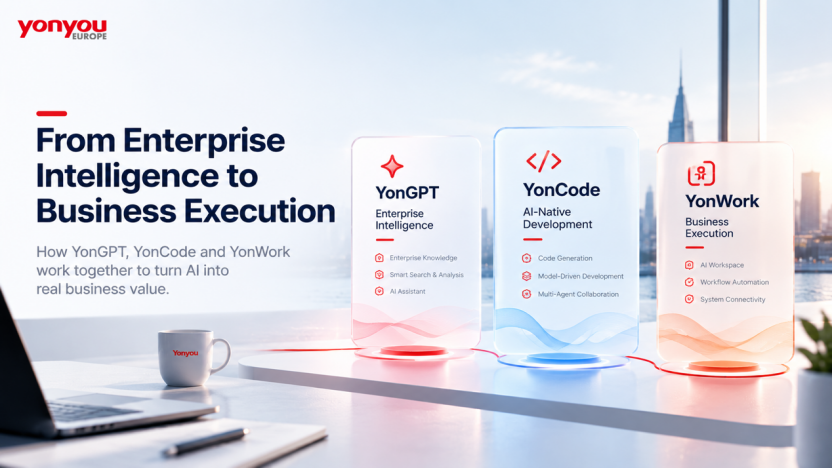
Discover how YonGPT, YonCode and YonWork address three essential areas of enterprise AI: business intelligence, AI-native application development and intelligent workflow execution.
Introduction: Enterprise AI Needs More Than a Powerful Model
Artificial intelligence is transforming how organizations manage information, develop applications and perform everyday business tasks.
Large language models (LLMs) have made it easier to interact with technology through natural language. However, generating accurate responses is only one part of enterprise AI adoption.
Businesses also need to connect AI with organizational knowledge, existing software and operational workflows.
An AI model may help employees understand a document. An AI-powered development platform can help build an application. An enterprise AI agent can support the execution of business tasks.
These capabilities address different challenges, but they share a common objective: turning AI technology into practical business value.
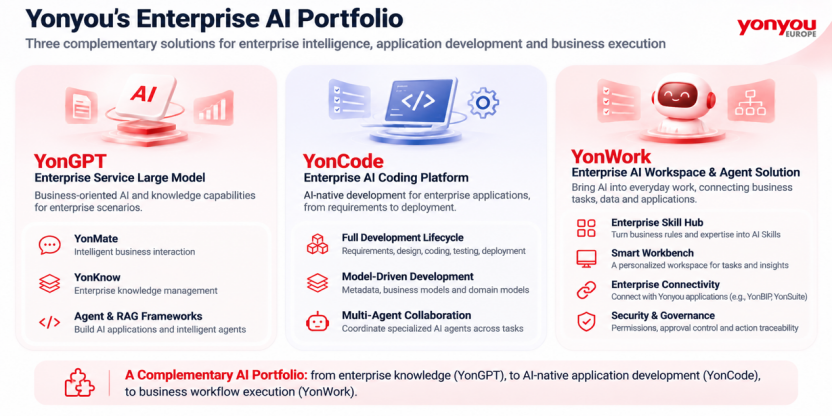
Yonyou’s enterprise AI portfolio includes three solutions that reflect these priorities: YonGPT, YonCode and YonWork.
1. YonGPT: Building Intelligence Around Enterprise Knowledge
General-purpose AI models can generate text, summarize documents and answer questions. However, enterprise applications often require specialized business knowledge and an understanding of organizational processes.
YonGPT is Yonyou’s enterprise service large language model, designed around business-oriented intelligence and industry knowledge.
It supports applications such as business analysis, knowledge retrieval, document understanding and intelligent decision assistance.
Making Enterprise Knowledge More Accessible
Organizations accumulate valuable information across policies, contracts, reports and internal documents.
Finding relevant information can be time-consuming, particularly when knowledge is distributed across different departments.
YonGPT’s enterprise AI capabilities include two important components:
YonMate – Intelligent Business Interaction
YonMate supports contextual conversations and the decomposition of complex requests into smaller tasks.
Its application scenarios include business insights, contract risk review, report generation, knowledge search and recommendations.
YonKnow – Enterprise Knowledge Management
YonKnow focuses on helping organizations organize and retrieve information from unstructured enterprise data.
It uses capabilities such as knowledge retrieval and knowledge graphs to support search, question answering and content creation.
Supporting Enterprise AI Applications
YonGPT also includes Agent and Retrieval-Augmented Generation (RAG) application frameworks.
Its AI Agent Builder is designed to support the creation of intelligent agents for different enterprise scenarios.
These capabilities provide organizations with ways to develop AI applications that use business knowledge rather than relying exclusively on general-purpose model responses.
Business value: Better access to organizational knowledge, more efficient information retrieval and AI-assisted business analysis.
Explore YonGPT – Enterprise Service Large Model
2. YonCode: Bringing AI into Enterprise Software Development
Enterprise AI adoption also creates new requirements for software development.
Organizations may need customized applications, new business workflows or integrations with existing enterprise systems.
Traditional development processes can involve substantial coordination between business analysts, architects, developers and testing teams.
YonCode is Yonyou’s enterprise-level AI coding platform, designed to support the development of AI-native enterprise applications.
Rather than focusing only on code generation, YonCode addresses the broader software development lifecycle.
From Requirements to Deployment
YonCode organizes AI-assisted development around five stages:
- Requirements Analysis: Interpret business requirements and organize functional specifications.
- Architecture Design: Develop application architecture, data models and implementation plans.
- Code Development: Support code generation and coordinated development tasks.
- Automated Testing: Generate test cases and assist with defect identification.
- Deployment and Launch: Support application builds, deployment and release processes.
The platform uses specialized AI subagents to coordinate activities across these stages.
Understanding Enterprise Business Context
Enterprise applications must reflect real business rules, processes and data structures.
YonCode emphasizes the use of enterprise context, including metadata, business models, page models and domain models.
This model-driven approach is designed to help AI-assisted development produce applications that are more consistent with organizational requirements.
YonCode also supports agentic-native application development, enabling applications to interact with AI agents and agent-oriented workflows.
A Practical Enterprise Example
Consider a company that needs an internal application for managing supplier requests.
An AI-assisted development process could help transform documented requirements into application designs, generate parts of the implementation and support testing.
The resulting software would still require appropriate validation, security assessment and deployment controls.
Business value: A more coordinated approach to enterprise application development, with opportunities to reduce repetitive development work and improve consistency.
Explore YonCode – Enterprise AI Coding Platform
3. YonWork: Connecting AI with Everyday Business Execution
While AI models provide intelligence and development platforms help create applications, employees also need practical ways to use AI in their daily work.
This is where enterprise AI agents and AI workspaces become important.
YonWork is Yonyou’s enterprise AI workspace and agent-oriented solution, focused on connecting business requests with information, workflows and authorized actions.
From Business Requests to Coordinated Tasks
YonWork is designed to help employees interact with enterprise processes through an AI-powered working environment.
Its capabilities include:
- Enterprise Skill Hub: Turning business rules, processes and organizational expertise into reusable AI Skills.
- Smart Workbench: Bringing prompts, tasks and business updates into a personalized workspace.
- Enterprise System Connectivity: Supporting connections with Yonyou business applications, including YonBIP and YonSuite.
- Security and Governance: Supporting permission management, traceability and controlled execution.
- Deployment Options: Supporting different deployment environments, including cloud and on-premises configurations.
Where YonWork Can Be Applied
YonWork’s product page illustrates several enterprise business scenarios.
Expense Reimbursement: Supporting receipt processing, expense compliance checks and reimbursement-related tasks.
Executive Business Analysis: Helping managers investigate business information and prepare decision-oriented insights.
Talent Management: Connecting workforce information and talent-related activities within business workflows.
Customer Order Fulfillment: Supporting the coordination of order-related information and execution across enterprise processes.
These scenarios illustrate how AI can move beyond answering questions toward assisting with operational tasks.
For organizations, the objective is not to remove human involvement but to reduce unnecessary manual coordination while maintaining appropriate controls.
Business value: More accessible enterprise workflows, improved task coordination and AI assistance embedded in daily operations.
Explore YonWork – Enterprise AI Agent and Workspace
4. Three Complementary Approaches to Enterprise AI
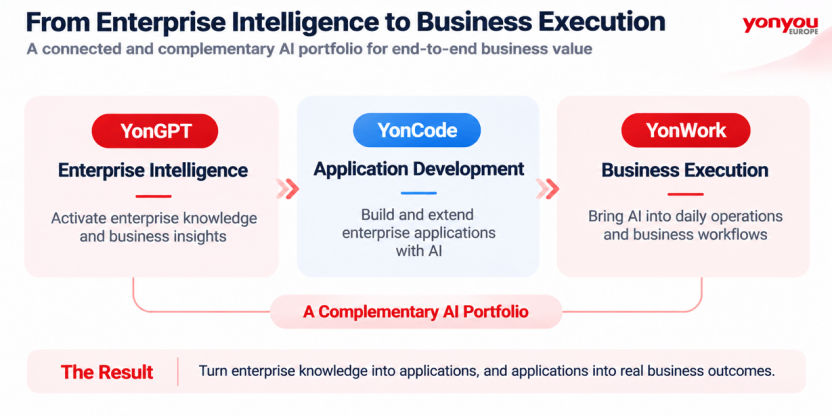
YonGPT, YonCode and YonWork address different parts of enterprise AI adoption.
| Solution | Primary Focus | Business Application |
| YonGPT | Enterprise AI models and knowledge capabilities | Knowledge retrieval, intelligent assistance and business analysis |
| YonCode | AI-native application development | Requirements, architecture, coding, testing and deployment |
| YonWork | AI workspace and agent-oriented execution | Business tasks, workflow coordination and enterprise interaction |
For example, an organization might first improve access to internal knowledge, then develop a specialized business application, and finally introduce AI-assisted workflows for employees.
These are complementary opportunities rather than a mandatory implementation sequence.
Each solution can be evaluated according to the organization’s business requirements, existing technology and deployment environment.
5. What Should Enterprises Consider Before Adopting AI?
A successful enterprise AI strategy starts with business requirements, not product selection.
Organizations should evaluate:
Business Objectives: Which processes need improvement, and how will success be measured?
Data and Knowledge Readiness: Is the information accurate, accessible and properly governed?
Integration Requirements: Which enterprise applications and workflows need to connect with AI?
Security and Compliance: How will permissions, sensitive information and approval processes be managed?
Implementation Feasibility: Which capabilities are available in the required product version, region and deployment model?
For European organizations, data protection, governance and operational accountability should be considered from the beginning.
A focused pilot can help validate practical value before broader adoption.
Conclusion: Turning Enterprise AI into Business Value
Enterprise AI is evolving beyond standalone language models and conversational assistants.
Organizations increasingly need AI capabilities that understand business information, support application development and connect with operational processes.
Yonyou’s YonGPT, YonCode and YonWork reflect these different requirements.
YonGPT focuses on enterprise intelligence and knowledge. YonCode supports AI-native software development. YonWork brings agent-oriented assistance into everyday business workflows.
Together, they illustrate a broader direction for enterprise AI: connecting intelligence, applications and business execution.
At Yonyou Europe, we work with organizations exploring enterprise software, intelligent applications and digital transformation.
Interested in exploring enterprise AI solutions for your organization?
Contact Yonyou Europe to discuss your requirements and identify relevant opportunities for AI adoption.
Frequently Asked Questions
What is the difference between YonGPT and YonWork?
YonGPT focuses on enterprise large language model capabilities, knowledge applications and intelligent interactions. YonWork focuses on an AI-powered workspace and agent-oriented business task execution.
What is YonCode used for?
YonCode supports AI-assisted enterprise application development, including requirements analysis, architecture design, coding, testing and deployment.
Do businesses need all three solutions?
Not necessarily. Each product addresses different requirements. The appropriate solution depends on business objectives, technical architecture and available integrations.
Can these solutions work with ERP systems?
Yonyou’s enterprise AI portfolio includes capabilities for connecting intelligence with enterprise applications. Specific integration options depend on the products, versions and deployment configurations involved.
